Connect
Raven Link
Connectivity that survives contact. When normal comms fail, the network holds.
Keep soldiers, drones, sensors, and command connected where standard links break down.
Overview
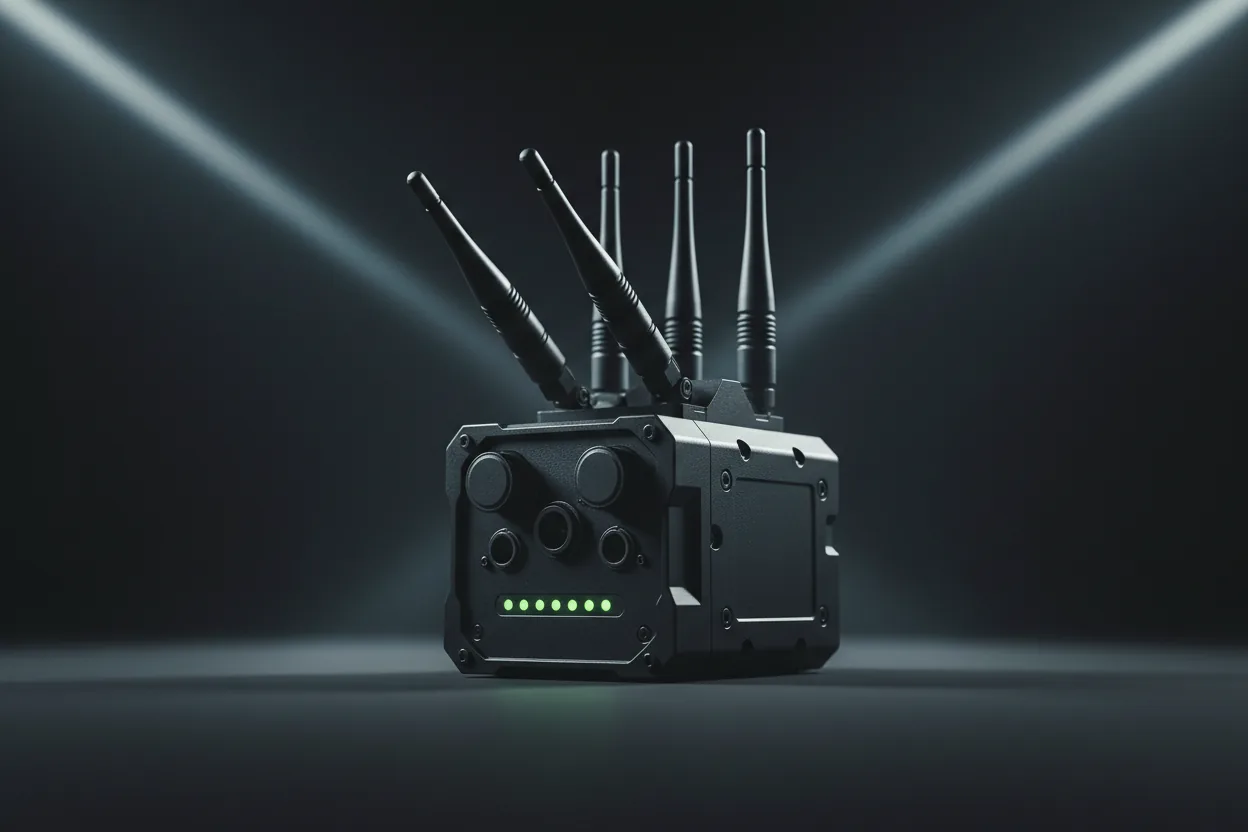
Raven Link is a rugged tactical communications gateway for secure, resilient command-and-control connectivity in difficult, remote, or contested environments. It keeps data flowing between soldiers, drones, sensors, vehicles, cameras, autonomous platforms, and command centers when conventional links are degraded, overloaded, or unavailable.
An onboard IP border router carries ordinary network traffic — SSH, web, VoIP, telemetry, alerts, and control messages — over the radio link, so existing systems work without modification. Proprietary fast frequency hopping exceeding 1,000 hops per second across Sub-1 GHz and 2.4 GHz shifts the signal faster than wideband jamming systems can track. Transmit power is dynamically minimised to the lowest level that sustains the link, shrinking the RF footprint. When a jammer does engage, adaptive forward error correction recovers packets from partial symbol erasure to sustain throughput.
To defeat adversarial electronic support measures, Raven Link employs Ghost Node spectral deception — generating phantom traffic on unused frequencies to create the appearance of multiple active nodes across both bands, complicating ESM attribution and direction-finding. A stealth long-range mode drops to minimum data rate and power for covert operation at extended distances; a high-speed mode shifts to 2.4 GHz for throughput-intensive short-range links. Multiple nodes can operate in synchronised coordination for networked deployments.
Raven Link is not a radio modem. It is a covert network appliance built for operations where the link itself is a tactical asset.
Military & security use cases
- Resilient C2 links in jammed or congested RF environments
- Drone telemetry and control relay beyond standard radio range
- Covert sensor-to-command data backhaul
- Forward operating base and checkpoint connectivity
- Electronic warfare-resistant comms for autonomous platforms
- Backup communication layer for remote or degraded-link operations
- Resilient comms for critical-infrastructure security
What it delivers
- Standard IP applications work over a hardened link without modification
- Link survives active jamming through fast hopping and adaptive error correction
- Minimal RF footprint — adversaries have less to find, fix, and exploit
- Ghost Node deception complicates ESM detection and attribution
- Selectable range-vs-throughput modes to match the mission
- Synchronized multi-node capability for networked field deployments
- Compact, deployable form factor for the digital battlefield
Key capabilities
Inside Raven Link.
- LPI/LPD by design — minimised RF footprint, hard to detect and intercept
- Proprietary fast frequency hopping exceeding 1,000 hops per second
- Dual-band operation — Sub-1 GHz for range and NLoS, 2.4 GHz for throughput
- IP border router — routes standard traffic (SSH, web, VoIP, telemetry, control) without modification
- Adaptive transmit-power control: link power matched dynamically to conditions
- Ghost Node spectral deception: phantom traffic on unused frequencies to confuse ESM
- Adaptive forward error correction: packet recovery under active jamming
- Stealth long-range mode for minimum RF signature at extended distances
- High-speed mode for throughput in urban or short-range scenarios
- Strong non-line-of-sight performance over difficult terrain
- Synchronized multi-node operation for coordinated network deployments
- Compact, deployable appliance
Product FAQ
Raven Link — questions & answers
How is Raven Link different from a radio modem?
It is an intelligent tactical network appliance: edge computing paired with adaptive dual-band radio that lets standard IP-based systems operate over a hardened wireless link.
When would we deploy Raven Link?
When conventional links are degraded, overloaded, or unavailable — as a tactical field gateway, drone communication relay, sensor-network bridge, backup communication layer, or mobile command node.
How does it perform in non-line-of-sight conditions?
It offers better non-line-of-sight performance than simple telemetry links and stronger resilience against interference, in a compact, deployable form factor.
Rest of the system

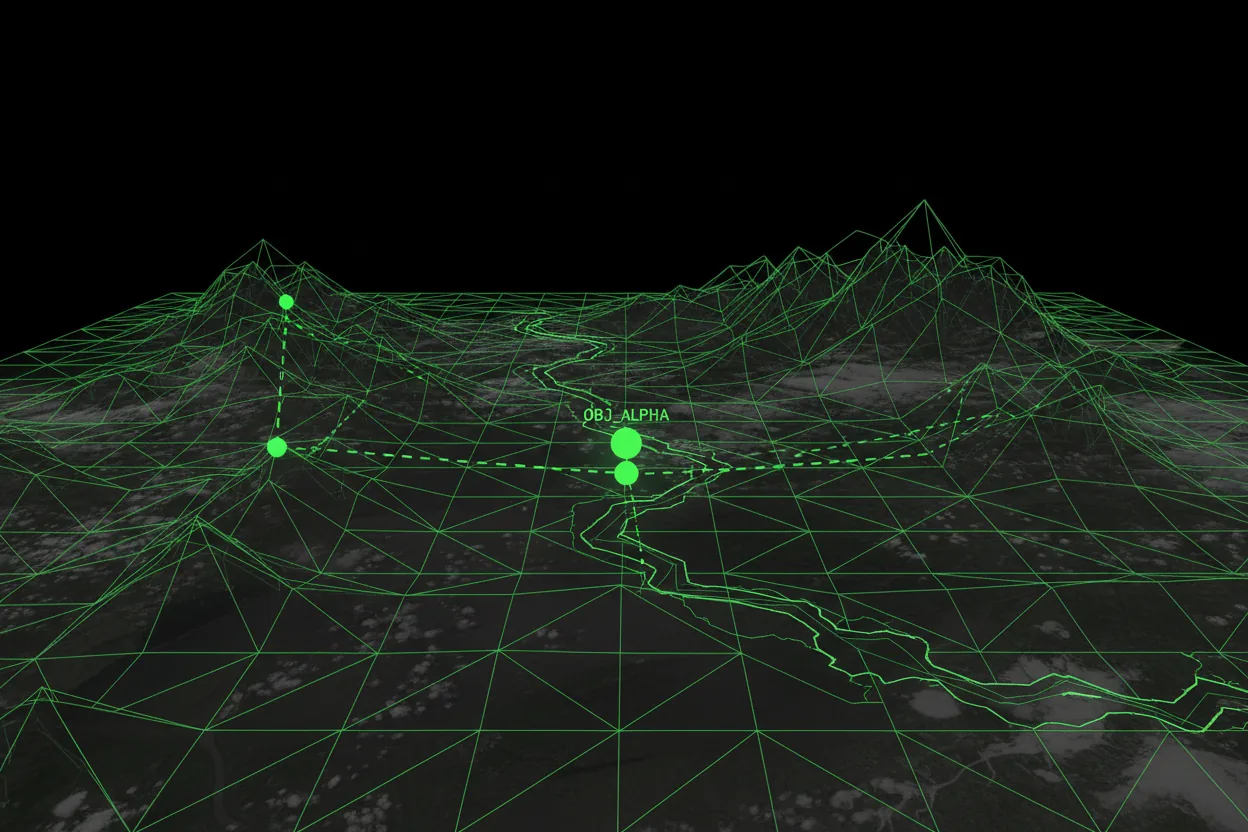

Put Raven Link to work.
Tell us about your mission and we'll show you the system in context.